


Jean-Pierre Nadau was born on May 9, 1963, in the Paris suburb of Melun. He grew up and graduated from high school in Vert-Saint-Denis, north-central France, where his father was the manager of a precision-tool manufacturing company.
As a teenager, Nadau’s passion for music led to a deep, rich and eclectic interesting contemporary creative trends. Hiscuriosity extended to film and theatre culture, and he wanted to become an actor. He went on to study at director-actor Charles Dullin’s Ecole de Theatre in Paris for three years in 1982, intending to go into theatre and writing; at this time, there was no indication of his future as a painter.
In 1984, Nadau had a revelatory encounter with Roger “Chomo” Chomeaux (1907-1999), the hermit-artist of the forest of Fontainebleau near Paris. Suddenly, in 1986, Nadau stopped acting so that he could work with Chomo in the forest. Later, in 1988, Nadau began to draw, partly inspired by the work of Augustin Lesage (1876-1954). Nadau drew many small-format, black-and-white works before starting to paint on a huge scale (up to 36 feet/11 meters) on paper or canvas.
Having lived off-and-on with his parents during his youth while holding various odds jobs, Nadau moved to Reims, the capital of Champagne, north-east France, for several years before settling in a chalet in Morillon, haute Savoie, in the French Alps. He continues to live and create there - heights inspire him, as does being close to the sky. Nadau's works have been shown in over 150 solo and collective exhibitions across France and Europe, as well as in the United States, Canada, Japan and Australia. His works are also held in the Collection de !'Art Brut, Lausanne.
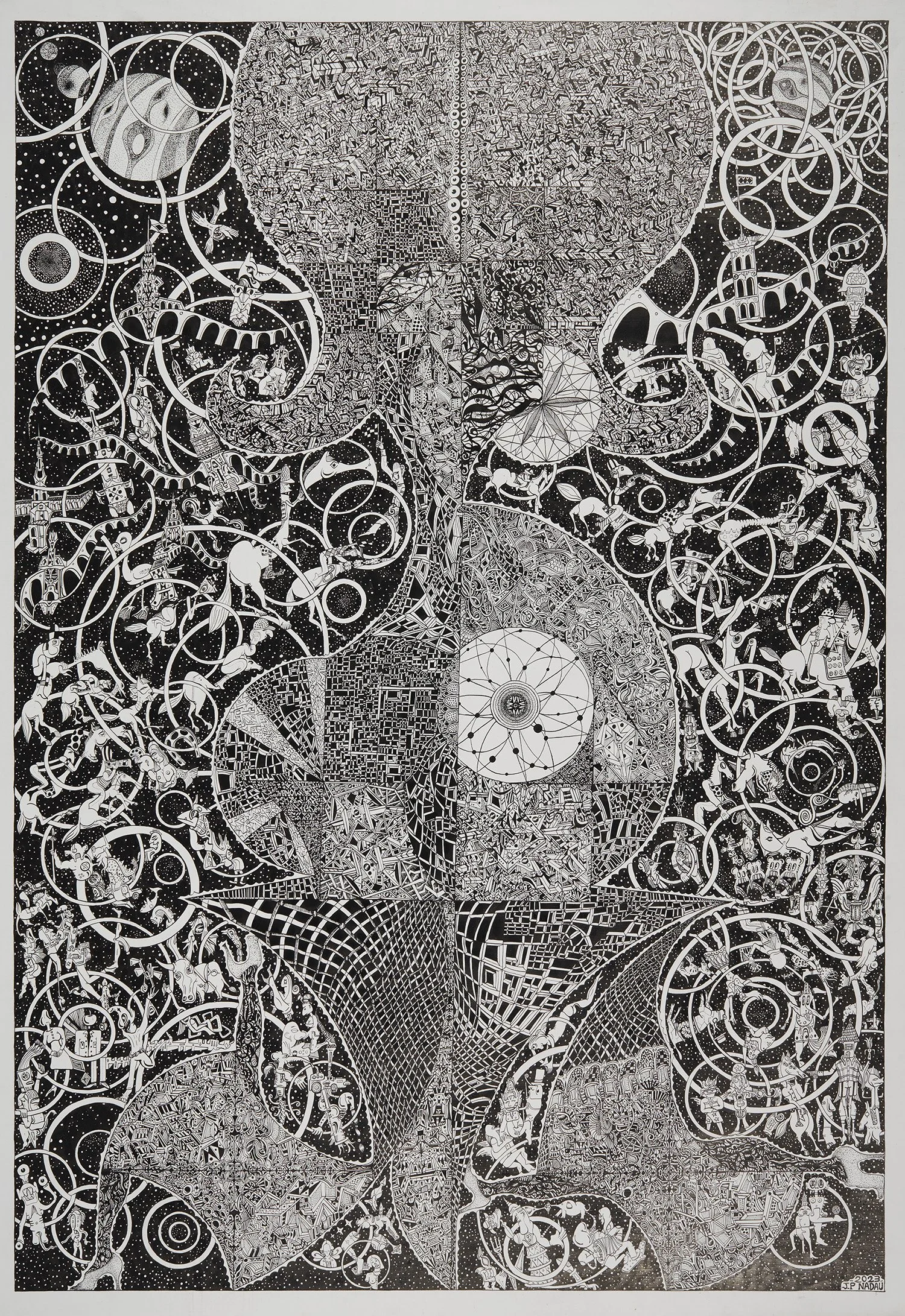
Nadau's compositions are filled with fantastical architectural structures, wacky stories and tragicomedies, all with an underlying ribaldry. Among the themes that drive him are horse or bicycle races, and French gardens: it seems that there must be movement and growth, or else there would be stagnation.
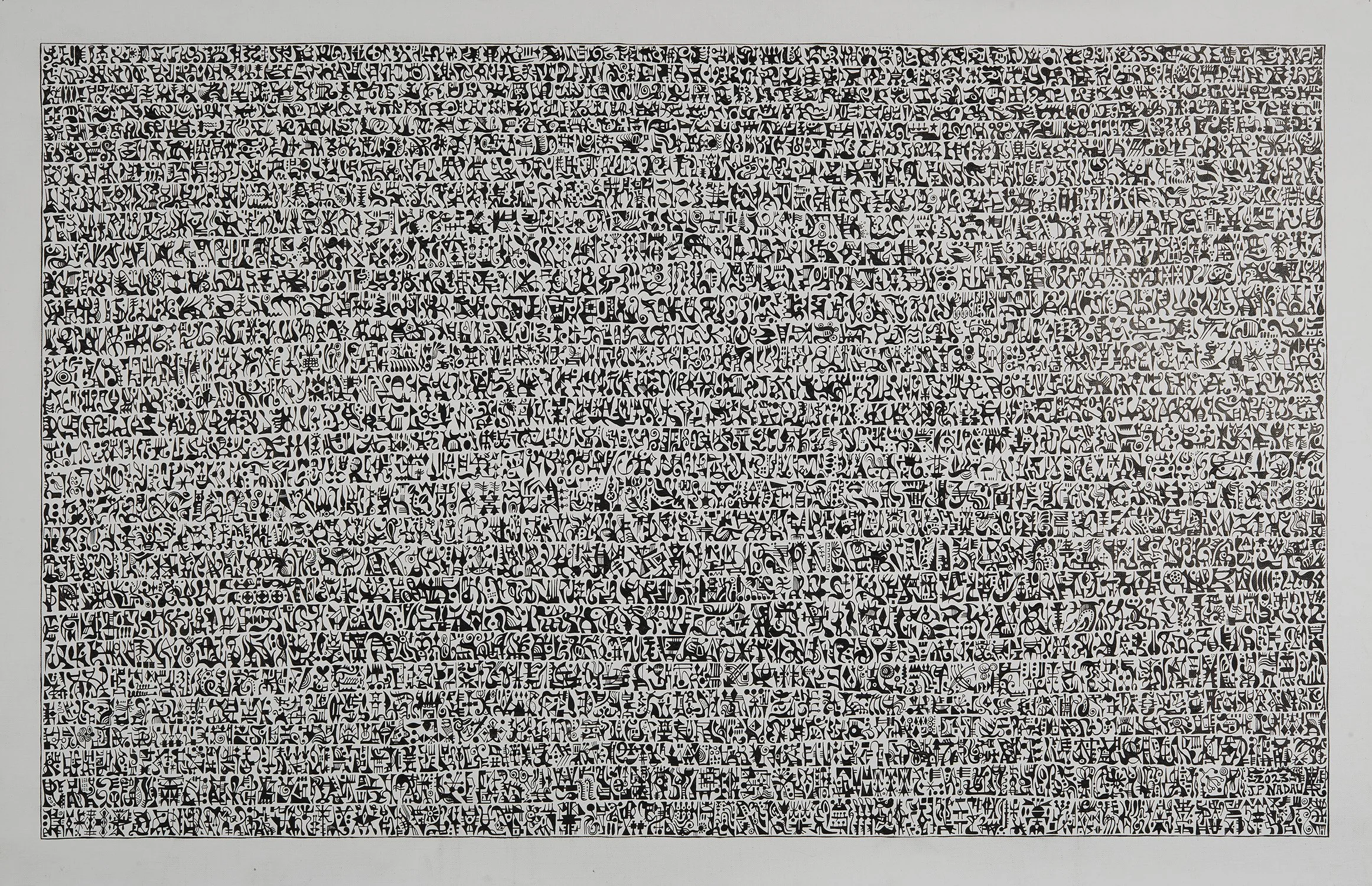
Of his technique, Nadau says, "I drew with a Sergent-Major pen nib and India Ink. I discovered a world I never imagined before. And for the past 25 years, I have worked obsessively, slightly organizing more or less simple geometrical forms, drawn in a small scale and then transposed into a larger scale. I let myself go into the burlesque side of the impossible things that go on between the characters. In a happy frenzy, I let everything go by, unconstrained. I don't try other techniques, having no project in that direction. My own technique is enough. I have preferences such as geographical maps. I invent imaginary writings, with small characters, drawn in line-like pictograms."
When Nadau first started making his drawings, there was the beginning. Then came his personal "Big Bang" – a creative explosion that led to all of the drawings to come forth from his hand. An unconstructed, latent, unfathomable and virtual universe from which anything could be created was suddenly within reach of his pen's nib. Ink trails were left like small, black pebbles in the form of magical, spatial letters or characters that left their mark on the defenseless, pristine paper.
Nadau's surprising, funny and libertarian mental-maps are never overloaded. Alongside intricate detail are larger images and overviews. Beneath his topography is a powerful, shamanic, infinite void, buried under the dust f his symbols. How he navigates through the tiny through to the immense formats is by improvisation, often by series. Nadau explained, "It starts from a small thing that develops little by little: a stretched dot or a small line. I explore my own drawing. Improvising is a!ways present, even on canvas. There is no repentance, which makes fun telescoping possible. There is no void. I can't leave anything empty, it's like a big spiderweb."
There is no scale in Nadau's art: microcosmos and macrocosmos are intertwined in a subtle, aerial and prodigious world where everything is weightless and nothing is easily identified. What one drawing offers, another takes back. What materializes at one point ism odified in the next line. Nadau's saturated compositions re refreshing and his creative fury stays with him, in his scabrous and comical visual secrets.
Inventing an unexplored and absolutely innocent world, Nadau’s symbols thrive without mankind - attacking the vacuum from which they spring to bring forth life. Tired of the heavy burden of Western certainties, he constantly invents new writings. His works and gestures can be reminiscent of the fragile and empty traces of Cy Twombly (1928-2011) or the intoxicated drawings of Henri Michaux (1899-1984), the fabulous inventor of a frenetic, feverish archaic and musical alphabet, but Nadau is drier and more precise and he reinvents the world in an iconoclastic and pleasurable way.
His ink and paint works are like his imagination’s exuvial (the abandoned skin or exoskeleton of a snake or insect), resembling the sacred signs of ancient Egypt if the hieroglyphs were carved out by a hallucinating, merry joker. Despite this, artistic aesthetics are respected. The impact of his work is beautiful, and his capacity to express so much with few elements is striking. This unconventional drifter, never drifting from himself, moves his lines in small vibrating steps in another mental world where he remains completely focused. His inner depths continue to dazzle and ignite viewers, and art feeds on these hot embers.