

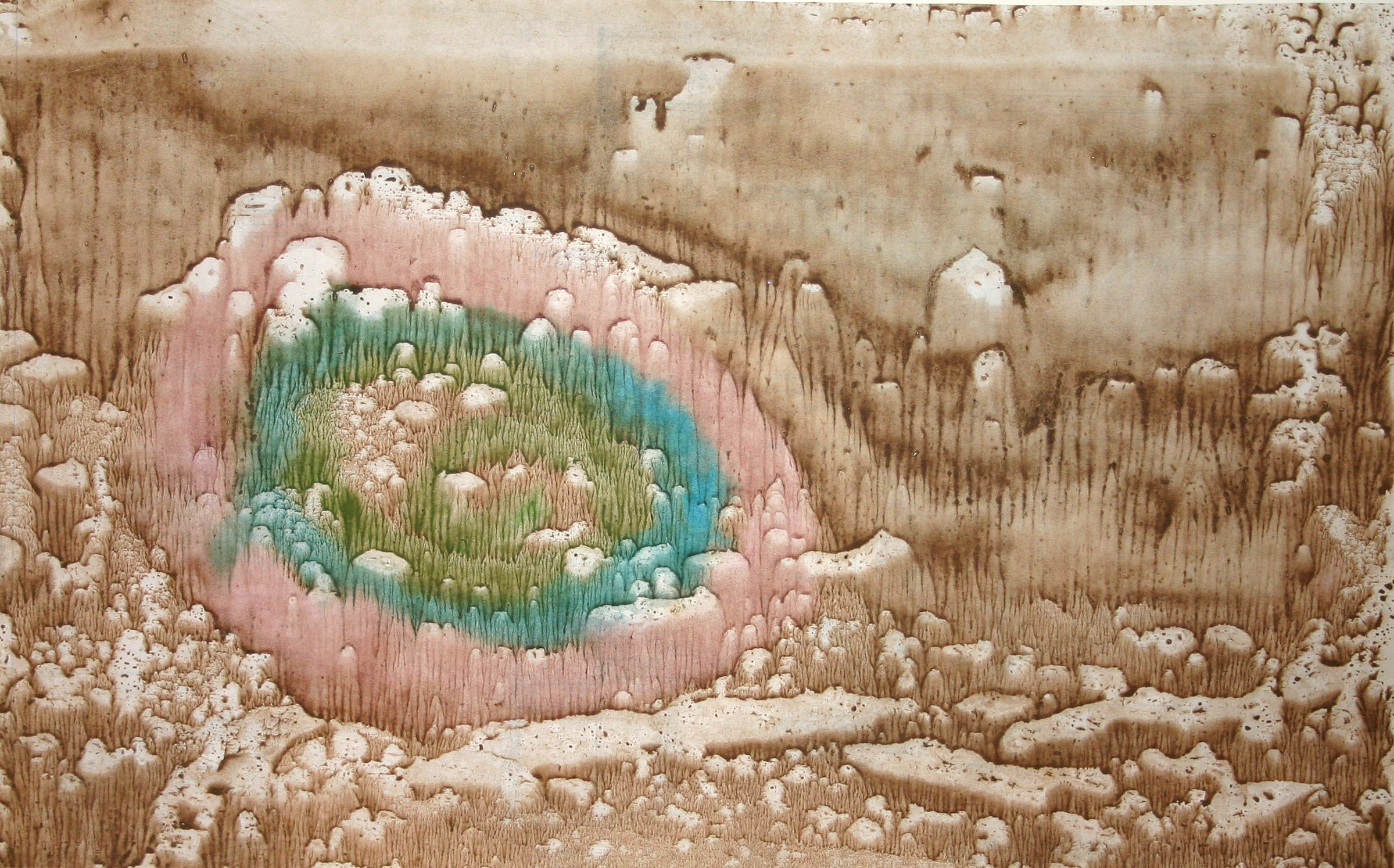


Melvin Edward Nelson (1908 – 1992) left Michigan at the age of twenty-six, after experiencing an epiphany that he could tele-transport himself into the cosmos, looked down on earth and see the formation of other worlds. He believed that God had granted him the special otherworldly gift to see true views of atoms, the earth, and the solar system. Moreover, he was compelled to faithfully serve in the capacity of an official recorder of Truth that was at once spiritual and scientific, for he had sat in the heavens as well as behind the microscope. During the 1960’s he produced hundreds of drawings and watercolor series into two distinct categories.
His photo genetics series explored the magnetic life of the atomic microcosm where spiritual atoms were controlled by magnetic light and material atoms were controlled by magnetisms. To prove his thesis that the microcosm and macrocosm were inseparable, he crushed his own rocks and clays to create pigments. Then he added a secret ingredient to benefit all of mankind: “stardust” collected from UFO landings sites where the earth had been burnt on their touchdown. Nelson created these abstract works mixing pigment with water using what is basically the Surrealists technique of decalcomania; putting a layer of pigment on a sheet of paper and pressing (in Nelson’s case) a metal plate on top of it. Óscar Domínguez referred to this as decalcomania with no preconceived objective”.
His Sentra Photo Thesis revealed the relationship between these atoms and all the planets in the universe. Plus, all were painted by direct observation from his vantage point in outer space, which he reached via astral projection. He accomplished this with the aid of an invention he called the “anyzger” an “instrument of truth.” It was with this “same instrument that God can see all things upon earth below.” Nelson’s other inventions included “cyclotronic generator” for levitating objects and a “planetron” for generating cosmic energy. These inventions allowed for him to view outer space as well as receive communications from UFO’s.
Nelson conducted his out-of-body cosmic experiments on land he bought in rural Oregon after years of working for a Willamette Iron and Shipping company, active during World War II. The multiple acre parcel had numerous out-buildings built by the previous owners of the property. He lived in one, filling the others with books, papers, juke boxes, rock crushing machines; enough stuff to be considered a hoarder.
In 1970, the country in turmoil about the War in Viet Nam and the shootings at Kent State, the then governor of Oregon thought an event for “blowing off steam” was what young people needed, and with state money, organized the Vortex I music festival. It took place within miles of Nelson’s property where members of the Aquarian Church of Universal Service found Nelson—it was a good match. They helped Nelson on the property, and Nelson gave them shelter. The Aquarians promised to build Nelson an art studio and exhibition space, and in return, Nelson donated his farm to the Church.
The amicable relationship did not last. Nelson felt he had been hoodwinked when the Aquarians did not keep their promise, and he became violent. Finally, the Church sued Nelson who countersued. The judge in the case, who, suspicious of Nelson, relying on the testimony of a psychologist, declared Nelson to be schizophrenic with paranoid tendencies. The judge then ruled that an insane person could not legally bequeath property. The Aquarians, who by all accounts had cared for Nelson, were thrown off the property, and Nelson became a ward of the state, placed in a nursing home, and within two years passed away.
There is a coda to the story. Another person bought the property, tearing down the barn that housed Nelson’s inventions, selling the metal for scrap, and cutting down the trees. Other inventions and equipment were deemed useless and burned in a trench on the property. Once the new owner got a sense of what he considered rough, reactionary neighbors, he abandoned the property, which he believed had become unsellable. Time passed. Times were changing. The barns still standing on the land became a magnet for operators of a Meth lab. Finally shut down by the authorities, the structures were considered dangerously flammable because of the chemicals inside, thus were burnt to the ground. As the buildings burnt the firemen noticed shimmering reflections of light. When they could investigate, they discovered piles of coins that Nelson had hidden in the walls, payment for one of his futuristic machines that he had sold.
Extensive research on Melvin Edward Nelson was conducted by Peter Hastings Falk who wrote an unprinted monograph, The Cosmic Visions of Ed Nelson.